I can't tell you how many times a guy walks into The Vault, looks at a rack of 1970s Pendleton plaids, and says, "I love that, but I wouldn't know how to wear it." That's the whole thing about vintage outfits for guys — it's not about wearing a costume from a decade you didn't live through. It's about knowing the difference between a piece that's authentically old and a piece that's just old-fashioned. Every stitch has a story, and once you learn to read the labels, the zippers, and the seams, you can put together a wardrobe that looks like you — just with a little more history than the guy who buys his look off a fast-fashion rack.
I spent eight years in buying at J.Crew's New York office before moving to Savannah and starting over. Those years taught me how modern garments are spec'd, made, and priced — and they gave me a deep appreciation for the way things used to be built. When I'm picking pieces for the store, I'm not looking for "old" things. I'm looking for good things that happen to be old.
This is the guide I wish I'd had when I started digging. No gatekeeping, no "you must own these ten pieces." Just a practical way to think about vintage outfits for guys, one rack at a time.
Why Vintage Is Worth the Dig
Fast fashion is designed to be disposable. A $25 button-down from the mall feels fine at the register, but the cotton is thin, the stitching is loose, and the buttons are plastic. Compare that to a 1970s Arrow shirt with a union label still sewn into the tail. That shirt was made to be laundered, starched, and worn to work for years. The fabric has a heft to it; the collar rolls the way it should. You don't need a tailor to tell you the difference — you can feel it in your hands.
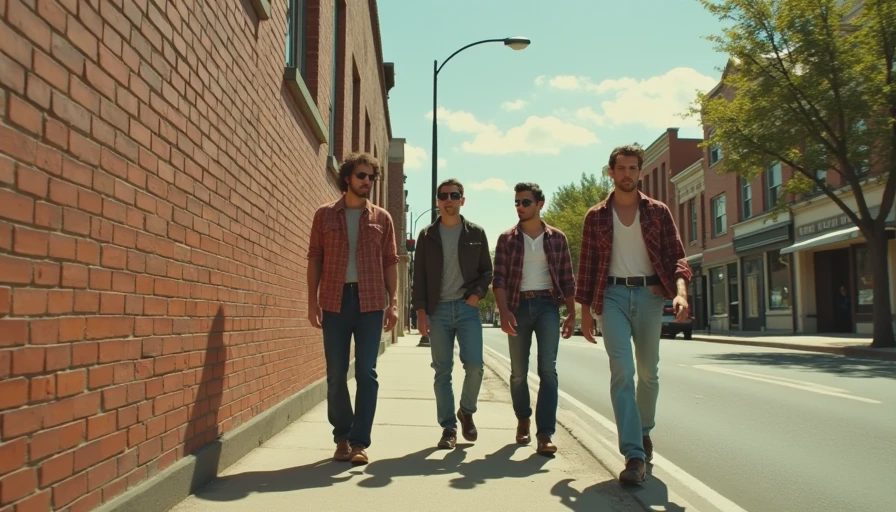
Vintage also gives you a kind of privacy. If you wear the same khaki chinos as every other guy at the bar, you're a supporting character. If you throw on a pair of 1970s Lee khakis with a single pocket on the leg and a Talon zipper, you at least make them ask a question. The great thing is that vintage pieces are still cheap — raw denim and well-made shoes aside, you can put together a solid rotation for the price of one new fast-fashion shopping trip.
Five Pieces to Start With
I get it — "start with the classics" is easy to say. But when I watch new vintage shoppers, the ones who end up with a complete outfit are the ones who start with a narrow, flexible set. Here's what I gravitate toward when someone asks me to build their first vintage outfit from scratch.
A denim jacket, preferably a Levi's type III from the 70s or 80s. It works over a t-shirt, a hoodie, or a Pendleton shirt. A pair of chinos from the 60s or 70s — Lee, Dickies, or Haggar, with a high rise and straight leg. A band-collar shirt, something from the 60s or 70s, in a fall color like rust or olive. A wool sport coat from the 60s or 70s — make sure the shoulders fit, and take it to a tailor if the waist needs help. And a pair of simple leather boots. They don't have to be vintage; even new boots look right when everything else has a past.
That's it. Five pieces, and you can create fifteen different looks by rotating them. The secret is proportion: vintage clothes were cut for a different body type, and you don't need a tailor to make them work if you pick pieces that match your actual size. I've seen a lot of guys try to squeeze into a tiny 1960s slim fit when they'd look better in a full cut from the 40s.

How to Read a Garment in Thirty Seconds
There's a myth that dating and judging a vintage wardrobe requires a degree. It doesn't. The zipper is your first clue. A Talon zipper, especially one with a brass pull, usually means pre-1970. A YKK zipper can be older than you think — Japanese-made YKK appears in the 60s, but the modern YKK with a plastic pull is usually post-1980. Check the back of the fabric for a union label, which tells you where it was made. A shirt with a full union label and a "Sanforized" tag is generally well made.
Then look at the seams. A straight, even seam with no wrinkles at the armhole means the garment was cut and sewn with care. If the fabric is a natural fiber like cotton or wool, you're already ahead. And here's a rule I live by: if a piece has thread that matches the fabric and no obvious repairs, you can always have it altered for less than you'd pay for a new shirt.
The Rules Are Simple
Here's what I want you to take with you from all this: vintage outfits for guys are less about a specific decade and more about a way of paying attention. Listen to the zipper, feel the fabric, and ask one question — would I wear this if it were brand new? If the answer is yes, take it with you.
And the costume problem? Let one vintage piece be the star. Pair a bold 70s shirt with modern, minimal everything else, or wear a vintage blazer with plain jeans and clean sneakers. Tailoring helps — a $20 alteration can make a $40 jacket fit like it was made for you.
Every stitch has a story. Some of them just need a little help finding a new chapter. Come by The Vault next time you're in Savannah, or browse the online shop — I'm always happy to talk through what you're looking for.



No letters yet — be the first to write.