Vintage Button Up Mens: A Buyer's Guide to Timeless Style
I’ll be honest—when I first started digging through thrift racks back in my J.Crew days, button-up shirts were the last thing I grabbed. They seemed too formal, too fussy. But somewhere between my fourth warehouse sale and my move to Savannah, I had a change of heart. Now I hunt for vintage button up mens shirts like they’re buried treasure. And honestly? They kind of are.
A well-made vintage button-up is one of the most versatile pieces you can own. Layer it under a sweater, wear it untucked with jeans, or dress it up with chinos. The fit is often slimmer and longer than modern fast-fashion shirts, which works better for tucking. Plus, the fabrics—oxford cloth, chambray, end-on-end broadcloth—actually breathe, unlike the polyester blends flooding today’s racks.
But finding the right one takes a little know-how. Let’s walk through what to look for, how to spot quality, and where to start your hunt.

Why Vintage Button Ups Stand Out
The biggest difference between a vintage button-up and a modern one is the construction. Before the 1990s, most dress shirts were made with single-needle stitching, lock-stitched buttonholes, and real mother-of-pearl buttons. You can feel the weight. The collar rolls naturally instead of looking starched. And the fabrics—especially vintage oxford cloth—have a softness that only comes from years of washing.
I’ve handled thousands of shirts at The Vault, and I can tell you this: a 1960s Arrow or Van Heusen shirt in good condition will outlast any current mall brand. The cotton was longer-staple, the seams were reinforced, and the buttons were sewn on tight. Plus, you get details like locker loops, box pleats, and sleeve plackets with actual buttons—not snaps. Those details tell a story.
When you’re shopping for vintage button up mens shirts, look for brand names like Hathaway, Gant, Brooks Brothers, and Sero. Also keep an eye out for union labels—those little tags often have a year number that helps you date the shirt. A tag from 1968? That shirt has been around longer than most of us.
How to Spot a Quality Vintage Button-Up
Not every old shirt is a gem. Here’s what I check in about 30 seconds.
First, the collar. Hold it up to the light. Are the points even? Is the interlining still crisp? If it’s floppy or frayed, skip it—collar restoration is a pain. Next, check the placket (the strip that holds the buttons). It should be stitched straight, not wavy. Also look at the buttons themselves. Real mother-of-pearl has an iridescent sheen; plastic looks flat. And if the buttons are stamped with the brand name or “m.o.p.,” that’s a good sign.
Turn the shirt inside out. Examine the seams. Single-needle stitching looks like a neat row of stitches with a slight gap. Double-needle (common on cheap shirts) looks like two parallel lines with no gap. Also check the gussets—the little triangular reinforcements at the side seams. On quality shirts, they’re shaped and stitched carefully, not just cut off.
Fabric is huge. Vintage cotton oxford cloth has a distinct softness—almost fuzzy from wear. Chambray should feel substantial, not papery. And end-on-end broadcloth (often used in 1960s dress shirts) has a subtle weave that looks solid from a distance but reveals a grid up close.
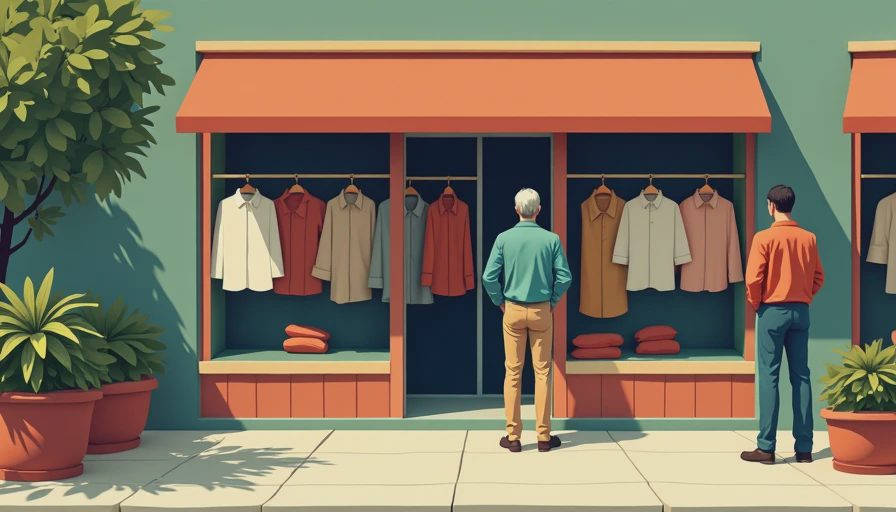
Styling a Vintage Button-Up Without Looking Like a Costume
The number one question I get at the shop is: “How do I wear this without looking like I’m in a period piece?” Fair question. The answer is balance.
If the shirt has a spread collar and a crisp look, pair it with raw denim or dark wash jeans—nothing overly distressed. Roll the sleeves once or twice to signal that you’re not heading to a board meeting. Untucked works if the shirt hem is straight (not curved like a modern shirt) and ends around your mid-fly. If it’s longer, tuck it in.
For a more casual vibe, go with a chambray work shirt—unbuttoned over a white tee, sleeves rolled, with chinos or duck canvas pants. Add boots or sneakers. That’s the kind of look that says “I appreciate quality” without shouting “I only shop vintage.”
And please, avoid wearing a vintage tie with a vintage shirt unless you’re going to a themed party. One vintage piece per outfit is usually enough.
Where to Dig: My Favorite Hunting Grounds
You don’t need to live in a big city to find good vintage button up mens shirts. Half my best finds have come from small-town thrift stores in Georgia and the Carolinas. Look for stores near older neighborhoods or retirement communities—that’s where the 1960s and 1970s clothing ends up.
Estate sales are gold mines. Go on the last day if you want bargains; go on the first if you want the best selection. Also check online marketplaces like eBay and Depop, but be specific with search terms: “vintage Brooks Brothers oxford button-down,” “1960s Arrow shirt,” “vintage Gant rugger.” Sorting by condition “used” and filtering by fabric will save you time.
At The Vault, I try to stock a rotating selection of cleaned and pressed vintage button-ups. I look for ones with minimal fade, intact buttons, and no funky smells. If you’re in Savannah, stop by—I’ll pull my favorites for you.
Final Word
Vintage button up mens shirts are more than just clothing. They’re artifacts of a time when things were built to last. Every shirt has a history—maybe it was worn to a first date, a job interview, or a Sunday picnic. When you buy one, you’re not just buying fabric. You’re becoming part of that story.
So next time you’re at a thrift store, don’t walk past the button-ups. Give them a look. Check the collar. Feel the fabric. And if you find a 1960s Arrow with mother-of-pearl buttons and a union label from ’68? That’s a keeper. Every stitch has a story.



No letters yet — be the first to write.