If you have come across the word derriers while searching for vintage trousers, you have probably encountered a misspelling or playful variation of “derrieres,” meaning the shape of the backside. In clothing, that detail matters more than most shoppers realize. A pair of high-waisted wool trousers can look magnificent from the front and strangely saggy from behind. The reverse is also true: a modest-looking pair can have a beautifully clean seat and suddenly make the whole outfit feel considered. When I inspect derriers, I am really studying cut, cloth, construction, and the way a garment hangs on a moving body.
Vintage clothing rewards this kind of attention. A 1950s trouser with a generous rise, a 1970s pair with a sharp center crease, and an early 1990s pleated chino all solve the same problem differently. None needs to fit like painted-on modern denim. The goal is balance: enough room to sit, walk, and climb stairs, with enough shape to avoid looking accidental. Every stitch has a story.
What derriers tells you about trouser fit
When I check derriers on a pair of trousers, I start with the waistband and work down. The seat should skim rather than pull tightly across the body. Horizontal drag lines usually mean the garment is too small through the hip or seat. Excess fabric folding beneath the waistband can indicate the opposite, though a tailor can often remove a modest amount without disturbing the original character.
Rise is the quiet hero here. A higher rise places the waistband closer to the natural waist and gives the trousers a longer, cleaner line through the hip. This is why old military chinos, surplus fatigues, and 1940s dress trousers often look so composed. Their patternmakers allowed the fabric to follow the body instead of forcing the body into a low-slung shape. Looking at derriers from the side also reveals whether the back rise is doing its job. If the waistband drops dramatically below the front, the cut may be wrong for you.
Try sitting down before you judge anything. A good pair should not pinch at the top of the leg or expose half your shirt. Stand, sit, and take a few steps. Clothing is not a museum display; it has to accompany you to the record store, the grocery aisle, and the Saturday flea market.
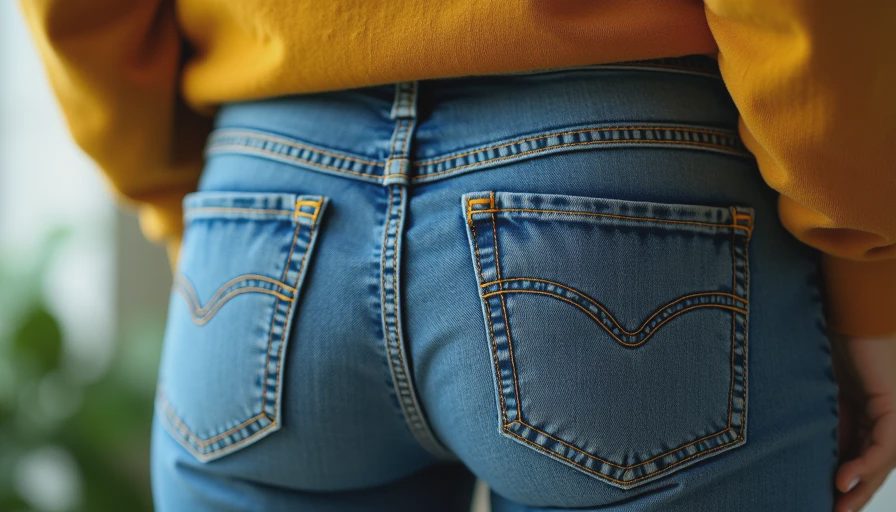
How fabric changes the way derriers look
Fabric can disguise or emphasize fit problems. Heavy cotton twill, such as the cloth used in classic Levi’s chinos and military khakis, holds a crisp shape and often improves with wear. Flannel and cavalry twill have enough body to create a smooth line without feeling stiff. Lightweight tropical wool drapes beautifully, but it will show every tension point if the seat is too tight.
Look closely at the weave and recovery. A vintage polyester-wool blend from the 1960s or 1970s may have survived in remarkable condition, especially when it came from a good maker. Brands such as Hart Schaffner Marx, Hickey Freeman, and Pendleton built many garments with practical cloth and sensible construction. A small amount of synthetic fiber is not automatically a flaw. Sometimes it is the reason a trouser still has a clean line after decades in a closet.
Corduroy deserves special mention. Its wale direction can make the backside appear broader or narrower depending on light, while worn ridges show where a previous owner moved and sat. That wear is information, not an automatic reason to reject a garment. Examine whether the fabric is thinning or simply softened. Derriers with honest wear can be more appealing than untouched trousers that never had a life.
Inspecting vintage trousers at the rack
A quick inspection can save you from bringing home an expensive mistake. First, hold the trousers at the waistband and compare the front and back rise. Next, check the seat seam for repairs, loose stitching, or shiny abrasion. Then inspect the crotch, where stress often appears before the rest of the garment. If the cloth is sound, small alterations are usually manageable.
Pay attention to hardware. A Talon, Scovill, or Gripper zipper can help place a garment in its era, but the zipper alone does not prove a date. Metal hooks, bar-tack reinforcement, branded snaps, and union labels provide better context when considered together. Look for labels from the International Ladies’ Garment Workers’ Union or older manufacturer tags, then compare the construction with known examples rather than relying on one detail.
When evaluating derriers, turn the trousers inside out. You may find a generous seam allowance, which gives a tailor useful room, or a crude alteration that explains an uneven seat. Check the pocket bags for staining and the lining for fraying. I once paid too much for a handsome pair of 1940s trousers because I admired the deadstock buttons and ignored a weakened seat seam. Beautiful buttons do not repair old fabric.

Tailoring derriers without losing the vintage character
The best alteration is usually a quiet one. A tailor can adjust the waistband, taper the leg, shorten the inseam, or slightly reshape the seat. The order matters. Establish the waist and rise first, because changing the leg before correcting the top can create a strange silhouette. Bring the shoes you expect to wear with the trousers so the hem lands properly.
Be cautious with major seat alterations. Removing an inch or more can shift the pockets, crease, and balance. Likewise, lowering a rise is not a simple fix; it can change the entire pattern and leave the trousers uncomfortable. If a pair is clearly too small through the hips, walk away rather than asking a tailor to perform a miracle. Vintage derriers should look lived-in, not engineered into submission.
For a typical thrifted pair, expect roughly $15 to $30 for hemming and perhaps $25 to $60 for a waistband or small seat adjustment, depending on the shop and construction. Those costs can turn a $12 find into a terrific wardrobe piece, but they should be part of the buying decision.
Styling a strong backside line naturally
A good fit does not require loud styling. Pair high-rise wool trousers with a tucked oxford shirt, a knit polo, or a cropped chore jacket. For denim, try a plain T-shirt under a vintage cardigan or a sturdy overshirt. The proportions should support the rise: a long, low-hanging shirt can hide the shape you chose the trousers to create.
Color helps too. Charcoal, tobacco, olive, and faded indigo are forgiving starting points because they work with boots, loafers, and simple canvas sneakers. If the derriers have a pronounced crease, let it lead the eye down the leg instead of piling fabric at the ankle. A clean hem usually does more for the outfit than a dramatic cuff.
Avoid treating fit as a size contest. A roomy seat can be elegant, practical, and historically accurate. A slimmer cut can work just as well when it allows movement. Your body is not supposed to imitate a mannequin; the garment is supposed to serve your body.
A final check before you buy
Before paying, stand in natural light and view the trousers from the front, side, and back. Sit down, walk a few steps, and reach into the pockets. Ask whether the fabric feels sturdy enough for regular wear and whether the necessary alterations fit your budget. If the answer is yes, you have found more than a pair of pants. You have found evidence of how someone dressed, worked, and moved through an earlier decade.
That is why derriers are worth discussing, even when the spelling sends you down an unusual search path. The backside of a garment reveals the honesty of its pattern and the history of its wear. Take your time at the rack, learn to read the zipper and seam, and trust comfort alongside your eye. Every stitch has a story, and the best vintage trousers let you wear the next chapter.

No letters yet — be the first to write.