If you've spent any time scrolling vintage resale sites, you've noticed the 90s style clothing mens market has exploded. I've been buying and selling vintage for over a decade, and the 90s is one of my favorite decades to hunt. It's not just nostalgia. The quality is still there if you know what to grab. Every stitch has a story, and the 90s tell a good one. This guide covers what to grab, what to skip, and how to wear the era without looking like you're headed to a theme party.
Why 90s Menswear Is Worth Digging For
Nineties garments sit in a sweet spot. They're old enough to be interesting but new enough to survive everyday wear. Unlike 70s pieces that often crumble at the seams, a well-made 90s denim jacket or flannel can easily go another 30 years. American and Japanese mills were still running strong, and construction standards were higher than what you'll find in most new clothes today.
That doesn't mean every 90s piece is gold. Fast fashion was creeping in, and by the late 90s you'll see plenty of thin, boxy, poorly made tees. The trick is knowing the difference between the good stuff and landfill filler.
The Two Eras of 90s Style
The 90s split into two looks. Early 90s (1990 to 1994) is grunge: oversized flannels, faded ripped denim, thermal henleys, and work boots. Think Nirvana in a thrift store. The key is a relaxed, lived-in fit. Late 90s (1995 to 1999) leans hip-hop and streetwear: XXL tees, baggy denim, nylon track jackets, and chunky sneakers. Colors got bolder — electric blues, oranges, that ubiquitous acid wash. A late-90s Tommy Hilfiger or Polo Ralph Lauren piece is a serious grail, but no-name brands capture the same vibe for less. Look for pieces with a boxy cut and dropped shoulders — that's the 90s silhouette that reads authentic without trying too hard.

The Building Blocks: What to Grab First
Denim is the backbone. Look for jeans with a high rise and a straight or relaxed leg. Levi's 501s and 550s from the 90s are everywhere in thrift stores, usually under $40. Check the care tag — "Made in USA" is a bonus. Silvertab and Girbaud are two brands that scream 90s.
Graphic tees are where vintage sellers make their money. A genuine 90s band tee can sell for $100 or more online. Look for a single-stitch seam along the sleeves, a boxy fit, and a "Made in USA" tag from Hanes, Fruit of the Loom, or Anvil.
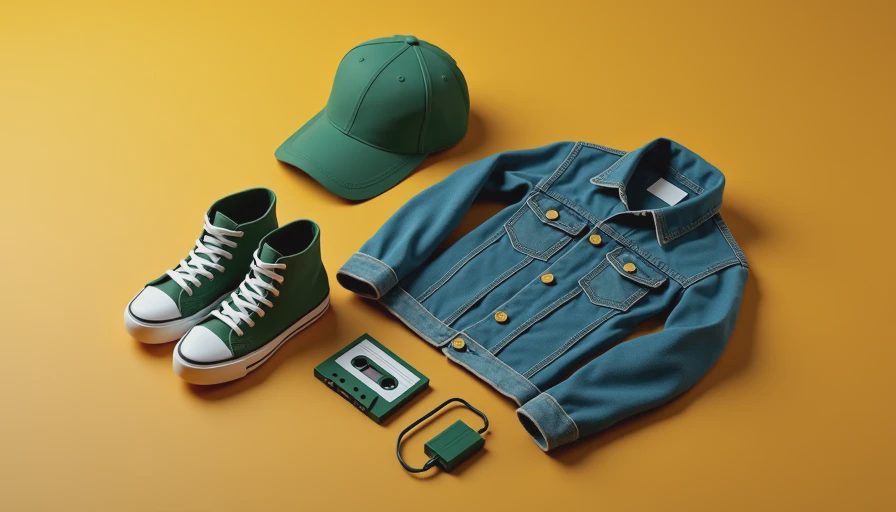
Flannel and plaid shirts are the easiest score. Pearl snap western shirts were huge, especially in the Southern states, and you can still find them in bins for $10. Rayon camp shirts are another staple — those colorful, silky button-downs that defined 90s casual wear. A 90s denim trucker jacket or nylon windbreaker instantly anchors the whole look. Woolrich and Pendleton flannels fetch higher prices, but a vintage no-name plaid wears just as well for a fraction of the cost.
How to Date a 90s Garment
Three quick checks tell you if it's real. Check the zipper. Early 90s used metal zippers from Talon or YKK; mid-90s switched to nylon coil. A plastic YKK zipper with a smooth pull is a good sign. Look at the tag. 90s tags are printed care labels, not woven satin. An RN number followed by a short code means it's 90s or later. Check the wash. 90s denim has a stonewashed or acid-washed finish that looks uneven. Modern repros look machine-distressed and uniform. If the finish looks laser-etched, put it back — that's a modern invention.
What You Should Pay for 90s Style Clothing Mens
Prices vary, but here's a realistic range from my time at the counter. In most US cities, expect $5 to $15 for a flannel, $8 to $20 for Levi's, and $3 to $10 for a graphic tee. Resale shops run higher: $20 to $50 for a nice flannel, $30 to $75 for a denim jacket. Online, a deadstock 90s tee with tags can hit $150 or more. A deadstock piece with original tags from a brand like Tommy Hilfiger can command double that in the right auction.
You don't need resale prices if you're willing to dig. I pulled a 1994 Champion reverse-weave sweatshirt out of a Savannah Goodwill bin for four dollars. It needed a wash, but it's one of my favorite pieces.
How to Wear 90s Without Looking Like a Costume
The secret is no head-to-toe staging. Pair one strong 90s piece with modern basics. Throw a vintage flannel over a plain white tee and clean sneakers. Wear a pair of 90s Levi's with a simple crewneck sweater. The trick is to let the vintage piece do the talking and keep everything else quiet. Fit matters more than era. A 90s piece won't look right if it's two sizes too big. Get it tailored — even a $10 thrift flannel becomes a wardrobe hero after a trip to the tailor.
Final Thoughts
The 90s style clothing mens movement isn't a passing fad. That decade left behind genuinely well-made garments that fit right into a modern wardrobe. Start with one piece — a great flannel or a well-worn pair of 501s — and build from there. Hit your local thrift stores, learn the tags, and don't be afraid to haggle at the flea market. When you find a piece with a story, wear it. And remember: every stitch has a story.


No letters yet — be the first to write.